Top 10 TV Table Manufacturers in China
China’s TV table industry spans large export factories, specialist cabinet makers, and brands with flexible custom production. This guide introduces ten manufacturers and compares the details buyers can verify: materials, dimensions, finish options, order quantities, and delivery support. A polished product photo is useful, but it cannot show everything. Ask for close-ups of edge banding, cable openings, drawer runners, and the rear panel.
For transparency, the quotation below is an editorially created line from a fictional industry specialist, not a sourced statement: “A good Tv Table supports the screen, manages the cables, and fits the room without demanding attention.” It captures a practical buying test. Check stated load capacity against your television and equipment, then confirm measurements against the wall, sockets, and floor space. Small details matter.
The manufacturers in this overview are assessed through publicly available product and company information, not factory audits. Treat the comparison as a starting point. Request current specifications, finish samples, and written confirmation of production terms before placing an order. Even careful research has limits; supplier capabilities can change, and online images may flatter a finish. A little skepticism helps.
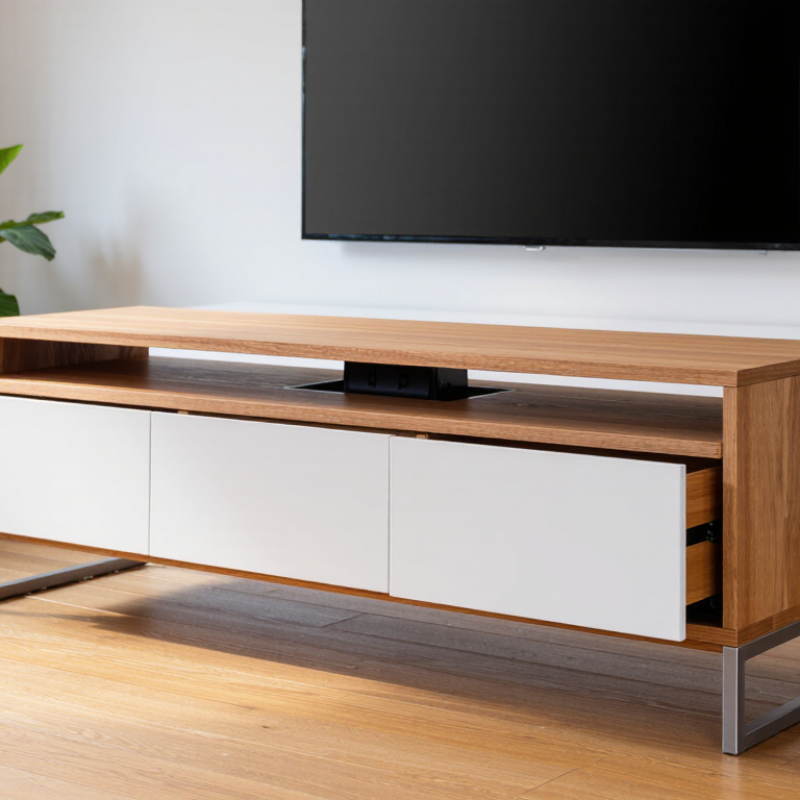
Overview of China’s TV Table Manufacturing Industry
China’s TV-table manufacturing sector is part of China’s much larger furniture industry. The National Bureau of Statistics reported that furniture manufacturers above designated size recorded RMB 655.7 billion in revenue in 2023, down 4.4% year over year. This figure covers the wider furniture sector, not TV tables alone, so it should not be read as a category-specific market estimate. Still, it signals the scale of the supplier base behind cabinets, media consoles, and related products.
Production commonly combines panel cutting, edge-banding, drilling, hardware fitting, and final assembly. A TV table may look simple, but its design must balance load capacity, stability, cable access, and finish quality. A narrow leg or poorly aligned drawer can affect daily use. Small details matter. Buyers comparing manufacturers can request drawings, material specifications, load-test records, and samples with the actual surface finish. Photos may not reveal chipped edges or loose fittings. One limitation is that public reports rarely separate TV tables from other furniture, while factory capabilities vary considerably. Those gaps make direct sample checks more useful than broad market claims.
China’s TV Table Manufacturing Industry: Material Reference
Representative density values for common TV table materials, shown in kilograms per cubic metre. Actual density varies by material grade and product construction. The logarithmic scale makes the differences easier to compare; these figures are material references, not China-specific production or market-share data.
Profiles of Ten TV Table Manufacturers in China
China’s TV table manufacturers often differ more in process than appearance.
Manufacturer 1 focuses on compact tables for apartments, with shallow shelves and cable openings.
Manufacturer 2 works mainly with solid wood, where grain and moisture control matter.
Manufacturer 3 combines metal frames with wood-look panels for a lighter, industrial style.
Manufacturer 4 offers modular units with adjustable shelves.
These profiles describe common factory specializations, not a ranking; actual capacity and quality vary by supplier.
Manufacturer 5 makes wall-mounted consoles and needs accurate drilling templates.
Manufacturer 6 specializes in glass tops, where edge finishing and protective packing deserve close checks.
Manufacturer 7 produces storage-heavy cabinets with drawers and doors.
Manufacturer 8 handles custom dimensions, though unusual sizes may affect lead times.
Manufacturer 9 supplies flat-pack designs, so fitting instructions and hardware consistency matter.
Manufacturer 10 focuses on larger media units and reinforced bases.
Small details count. A thin back panel can flex; a poorly placed vent may trap heat around equipment.
Tips: Ask for a current specification sheet, material samples, and close-up photos of joints and edges. Confirm load capacity, finished dimensions, cable access, packaging, and inspection steps in writing. If a sample looks excellent, still check the production unit. Samples can be better. Compare the same details across suppliers, and allow time to clarify anything vague.
Comparison of Products, Materials, and Manufacturing Capabilities
Top 10 TV Table Manufacturers in China: Comparing Products, Materials, and Manufacturing Capabilities
Comparing TV table manufacturers takes more than checking catalog photos. Look at dimensions, load ratings, cable openings, and storage layouts. A low console may suit a compact apartment, while a taller cabinet can better match a large screen. Ask for dimensioned drawings and confirm whether measurements include handles or feet. Small details matter.
Materials shape both appearance and service life. Engineered wood offers consistent finishes and flexible sizing, while solid wood brings natural grain and visible variation. Metal frames can improve rigidity, but joints and coatings deserve close inspection. Glass shelves need suitable edge finishing and secure supports. Request material specifications, finish samples, and packaging details. Samples help, but they do not prove every production batch will match.
Manufacturing capability is best judged through evidence, not broad claims. Ask about prototype approval, in-process checks, assembly testing, and how defects are recorded. Photos of a factory are useful, but limited. A trial order can reveal finish consistency, hardware fit, carton protection, and communication speed. No comparison is perfect; specifications may leave out real-world issues, such as a cabinet wobbling on uneven flooring. Check how the supplier handles that question before choosing.
Factors to Consider When Selecting a TV Table Manufacturer
Top 10 TV Table Manufacturers in China
Factors to Consider When Selecting a TV Table Manufacturer
Choosing a TV table manufacturer takes more than comparing prices and catalogue photos. Start with the product’s actual use: measure your television, soundbar, and available wall space. Check the stated load capacity, shelf spacing, cable openings, and stability. A sturdy table should sit level on your floor, with smooth edges and drawers that open without sticking. Ask which materials are used, including the thickness of panels and the finish applied to exposed edges. Small details matter.
Tips: Request a sample or a clear inspection report. Ask how the factory checks dimensions, surface finish, and hardware before packing. Confirm packaging details, production lead time, and how changes are handled. Get answers in writing.
A polished sample is useful, but it cannot prove that every unit will match. Ask how quality checks are recorded across a production run, and whether the manufacturer can share photos of finished goods and packaging. Discuss customization early; a new cable-hole position or leg design may affect cost and timing. Communication is part of the evaluation, too. Notice how clearly the team explains limitations, not just capabilities. I would still allow time to review a pre-production sample, because a small mismatch can look obvious once the table is in your living room.